Transformer ratio testing is an indispensable part of power equipment handover testing and preventive testing. According to the "Preventive Test Regulations for Power Equipment" and the "Handover Test Standards for Electrical Equipment in Electrical Equipment Installation Engineering", the transformation ratio test is listed as a mandatory test item for equipment grid connection and operation. Equipment that fails the test is strictly prohibited from being put into operation. This rigid requirement directly affects the reliability of detection data and the accuracy of equipment status evaluation in the selection of turns ratio testers.
Faced with a wide variety of turns ratio testers in the market, procurement and technical personnel need to conduct systematic evaluations from multiple dimensions such as transformer asset coverage, accuracy level matching, functional integrity, and on-site adaptability, rather than making decisions based solely on brand or quotation.
Accuracy level: the first threshold for selection
Measurement accuracy is the primary consideration factor in the selection of turns ratio testers. According to the relevant transformer manufacturing standards, the handover test of conventional distribution transformers requires an accuracy of not less than 0.2 level, while for main transformers of 220kV and above or factory inspections, it is recommended to use high-precision instruments of 0.1 level or even 0.05 level.
Range and Function: Adaptation from General to Special
The measurement range of the turns ratio determines the applicable boundary of the instrument. General purpose instruments typically cover a transformation ratio range of 0.8 to 10000, which can meet testing requirements from 10kV/0.4kV distribution transformers to 220kV/110kV power transformers. But when the business involves special equipment such as Z-type transformers, rectifier transformers, electric furnace transformers, or Scott transformers, whether the instrument is equipped with corresponding testing modules becomes crucial.
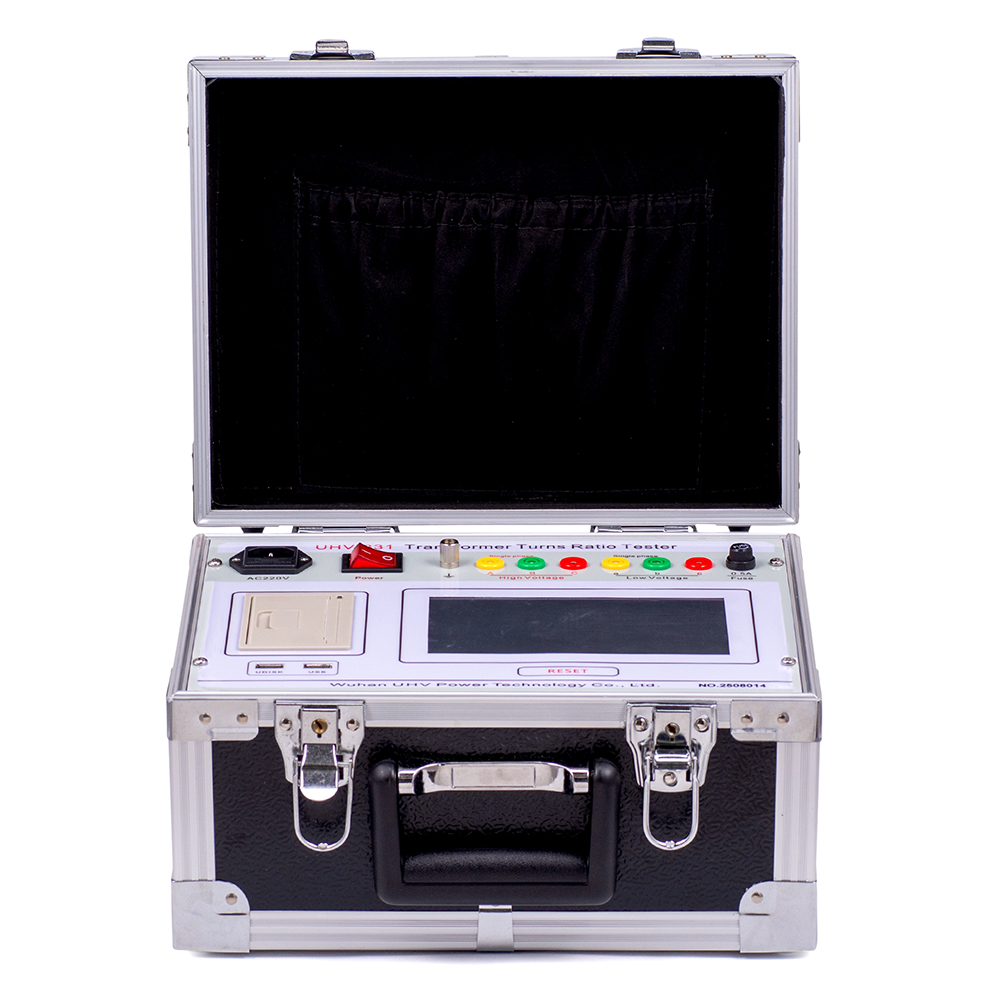
のfully automatic transformation ratio group tester for Wuhan UHV power has outstanding performance in supporting special transformers, and can adapt to various types such as Z-type transformers, rectifier transformers, electric furnace transformers, non integer phase-shifting transformers, balance transformers, and Scott transformers. It has full blind measurement function, which means that the transformation ratio and group number can be accurately measured without knowing any parameters of the tested transformer.
The blind testing function has significant value in actual on-site maintenance. When encountering transformers with unclear nameplates or wiring methods, instruments with this function do not need to input rated voltage and group information, and can automatically identify all parameters with just one click, greatly reducing troubleshooting time.
Three phase testing capability and phase angle accuracy
The essence of group testing is phase angle measurement. The phase angle resolution of high-quality instruments should reach 0.01 ° to avoid transformer operation accidents caused by misjudgment of groups.
In terms of testing methods, simultaneous measurement of three phases has significant time and consistency advantages compared to phase by phase testing. The Wuhan UHV fully automatic transformer ratio group tester adopts six channel simultaneous sampling to achieve true three-phase simultaneous measurement, testing the ratio and phase angle difference of high voltage to low voltage, and automatically calculating the ratio error and group.
For operation and maintenance units with a large number of on load tap changers, the automatic tap test function is also worth paying attention to. Instruments that support "one-time wiring and automatic completion of all tap position measurements" can automatically calculate tap values, errors, and generate trend curves, saving a lot of on-site labor compared to traditional manual switching methods.
On site adaptability and safety protection
The electromagnetic environment at the substation site is complex, and instruments need to maintain stable readings under the operating conditions of adjacent live equipment. Industry recommendations suggest that instruments should adopt three-phase synchronous measurement technology instead of time-division measurement, and have the ability to perform off frequency testing to isolate power frequency interference. The output voltage of the Wuhan UHV transformer turns ratio tester adopts an off frequency design, and the test results are not affected by fluctuations in the frequency and amplitude of the power supply.
The power supply method is a key consideration in field operation scenarios. Instruments with built-in large capacity lithium batteries and a battery life of no less than 8 hours can ensure continuous operation in substations or switchgear without mains power; Simultaneously retaining the AC220V plug-in function meets the requirements of laboratory batch testing.
In terms of safety protection, high and low voltage reverse connection protection, output short circuit protection, overcurrent protection, and emergency stop button should be the basic requirements for selection. The output terminal of the transformer ratio tester may generate high voltage during the testing process, and equipment lacking a complete protection mechanism poses a risk of burnout and operational safety hazards.
Data Management and Standardization Compliance
Modern turns ratio testers have evolved from simple measurement tools to data management systems. The instrument should have a storage capacity of no less than 1000 sets of data and support USB export and on-site printing functions.
In terms of compliance, when purchasing, it should be confirmed that the equipment has a third-party testing report recognized by CNAS, complies with the local power grid's material procurement specifications, and avoids the problem of being unable to be stored after procurement.
In the procurement decision-making process, it is recommended to first prepare a written selection technical specification document, clarifying the required transformer voltage level, transformation ratio range, group type, accuracy requirements, and usage environmental conditions to be covered, and then conduct product comparison based on this. The specification sheet should specify the range of transformation ratios and the accuracy indicators at the endpoints of the range, as most instruments have differences in accuracy performance at extreme values compared to their nominal values.